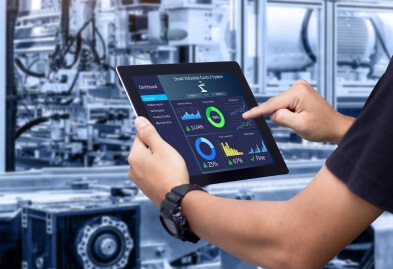
Next is the O.E.E., that’s your Overall Equipment Effectiveness. Through the IoT and Industrial Transformation, companies can now connect more of these devices, creating greater visibility and better metrics. Once you go through this transformation and connect these devices, instead of just having an overall view of “what’s our current availability” and “am I able to run my equipment?” you can answer more in-depth questions like “What is our available product?”, “How productive are we right now?”, and “are we building quality products?”. With Transformation and having more overall data points, you get greater and greater visibility and more granularity into your overall processes.
As mentioned previously, Digital Transformation can take shape in a number of ways due to its complexities. A possible reason for “pilot purgatory” is that achieving UI value, even in the 90th percentile, is in itself a lofty goal. In order to achieve this, manufacturers really need to remove waste wherever possible. Other investments in Digital Transformations that can be made to have a significant impact are tools like toolpath simulation software, quick-change tooling, and work holding, as well as tool presetting systems. We often hear that the majority of people believe that these are expensive systems. However, you can’t view it only as a cost because they are accompanied by a very quick ROI. Once those technologies are in place, with IoT, you’ll be able to analyze manufacturing processes and further improve on your O.E.E levels. Intelligent robots which are a component of Industrial 4.0 will serve to reduce labor costs, increase machine availability, and give personnel the ability to work on higher valued activities.
For Manufacturers, the 4th Industrial Revolution will mean the integration of technology throughout the manufacturing process. With this increase in available data, we need to be able to capture and present it to your teams in a meaningful and user-friendly way. The stakeholder will be able to extract valuable and relevant insights to improve the manufacturing comms. As mentioned, Digital Transformation to adapt to the 4th industrial revolution can start with smaller enhancements such as the digitization of paperwork and excel reports.
To learn more about the impact of the 4th industrial revolution and to learn how manufacturing organizations can adapt, watch our latest webinar: Manufacturing in 2020 & Beyond: Not Business as Usual