How to Reduce Technical Debt During Liferay DXP Upgrades: A Modernization Guide
Read time: 7 min



Digital Experience Platforms (DXPs) hold the promise of continuous evolution — richer capabilities, modern digital experiences, and better scalability. Solutions like Liferay DXP embody that promise, offering modular architecture, headless APIs, and integration flexibility that make modernization approachable even for legacy environments.
But in many enterprises, there’s a disconnect. Vendors release improvements rapidly — yet enterprises remain far behind. And in that gap, technical debt accumulates silently, quietly turning upgrades into multi-year projects instead of incremental improvements.
While leaders debate UX, personalization and cloud strategy, the silent challenge remains buried deep: unsupported customizations, outdated codebases, and rushed tactical fixes that slowly turn platforms brittle.
This is the hidden cost no one likes to acknowledge — but many eventually pay.
Liferay, like many leading DXPs, evolves continuously. Each major release brings enhancements — whether modular components, improved headless support, better performance, or updated security frameworks. Read more here.
However, large enterprises often grapple with:
The result: while vendors might be at version 12.x, many enterprises remain on older versions. This version gap leads to:
Each skipped release doesn’t just add an upgrade — it multiplies effort. It’s like skipping dental checkups for years and then needing a full (and painful) rebuild.
Customization isn’t the enemy — lack of governance is. Many legacy projects accumulate:
Though these may seem fast to implement, they soon become sources of upgrade-blockers. Enterprise after enterprise finds:
If upgrades concurrently force a “freeze everything” moment, you’re not delivering velocity — you’re accumulating risk.
To avoid becoming hostage to technical debt, enterprises need to build with the next upgrade in mind — not just the current feature. That means adopting patterns that make future upgrades smooth:
Enterprises that treat their DXP as a product, not a one-off project, win — because they build for tomorrow’s releases, not just today’s bug-list.
When each department builds independently on the DXP, you end up with a patchwork: redundant services, inconsistent UX, and fragmentation.
A composable architecture — one that’s modular, reusable, and governed — flips that. Benefits include:
This approach transforms the DXP into a scalable enterprise platform, not just a collection of siloed portals.
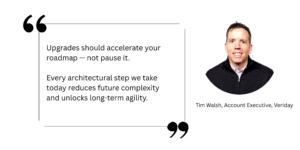
Not all platforms handle modernization equally. Liferay becomes a powerful foundation when you leverage Liferay.
With Liferay’s architecture plus upgrade-aware engineering practices, upgrades become manageable — even in the most complex environments.
Many get stuck because:
But it doesn’t have to be that way.
The difference is strategic investment: build once, reuse often. Refactor gradually, upgrade confidently.
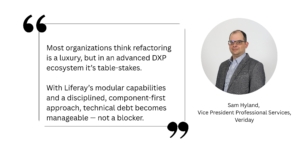
Veriday brings deep expertise in upgrading and modernizing Liferay deployments, especially for large enterprises in finance, insurance, manufacturing, and public sector. Using a proven methodology — refined over dozens of clients — Veriday helps:
By combining Liferay’s modern core with Veriday’s upgrade-friendly engineering and disciplined delivery, organizations can finally make upgrades predictable, safe, and value-driven.
No more “rip-and-replace.” No more frozen development. Just a clear path to long-term agility.
Upgrades alone aren’t the problem. Unmanaged technical debt is.
But with the right foundation — Liferay DXP — and the right approach — upgrade-friendly engineering + composable architecture — upgrades can become business accelerators instead of risk events.
If you’re ready to move from backlog to innovation, from debt to value — it’s time to change how you think about DXP upgrades.
Veriday helps enterprises modernize Liferay architectures and upgrade with confidence.
Request your Liferay Upgrade & Modernization Blueprint and start turning technical debt into a competitive advantage.
Q1: What is “technical debt” in the context of Liferay DXP upgrades?
Technical debt refers to the accumulated customizations, outdated code, unsupported modules, and structural inconsistencies that make Liferay DXP upgrades more complex, riskier, and time-consuming over time. If not managed incrementally, this debt can turn upgrades into multi-year, error-prone projects.
Q2: Why does technical debt build up in Liferay DXP environments?
Technical debt often accumulates when teams implement quick customizations, bypass standard APIs, duplicate portlets, or lack governance and modular design patterns. Over time, this leads to fragile integrations, inconsistent UX, and code that blocks easier upgrades.
Q3: How can enterprises reduce technical debt before upgrading Liferay DXP?
Enterprises can adopt upgrade-friendly engineering practices such as modular custom components, platform-first architecture, API-first integrations, automated regression testing, and reusable frameworks. Treating the DXP as a product instead of a one-off project helps lower debt and future-proof upgrades.
Q4: What role does composable architecture play in reducing technical debt?
Composable architecture unifies reusable modules, shared UI elements, and centralized content models, preventing the fragmentation and redundancy that frequently create upgrade blockers. This approach ensures consistent experiences and simplifies upgrade paths across teams.
Q5: Why is incremental upgrading better than “big bang” upgrades?
Incremental upgrades allow organizations to modernize one slice at a time, reducing risk and disruption. Rather than waiting to do a large version jump with unpredictable issues, incremental upgrades make planning, testing, and deployment more predictable and controllable.
Q6: How can companies measure and monitor technical debt in their Liferay platform?
Technical debt can be assessed through architectural reviews, code-quality analysis tools, regression testing results, performance baselines, and by cataloguing outdated customizations or fragile integrations. These insights help chart a modernization roadmap tied to business value.
Q7: How does Veriday help reduce technical debt and improve Liferay DXP upgrade outcomes?
Veriday brings deep upgrade and modernization expertise, helping organizations surface hidden technical debt, define modular frameworks, prioritize high-impact improvements, and manage incremental upgrades that align technical enhancements with measurable business benefits.

 Why Liferay DXP Is the Leading Strategic Differentiator Among Modern DXPs