Avoid Portal Pitfalls: How to Choose Between Low-Code and Custom Builds
Read time: 8 min


Enterprises today are under constant pressure to deliver digital experiences faster, with fewer resources, and across more channels than ever before. Whether it’s building a customer portal, a partner dashboard, or an employee experience platform — speed and agility are the new competitive advantages.
That’s where low-code and no-code (LCNC) platforms come in. They promise rapid development, less dependency on IT, and faster time to market — all appealing outcomes for organizations looking to modernize. But while LCNC tools can be powerful enablers, they’re not a universal solution.
For enterprise portals, where integration, scalability, and governance matter just as much as speed, the decision to go low-code (or not) requires careful evaluation.
Get a Free Integration Audit to evaluate your existing systems, identify automation opportunities, and see how low-code can accelerate delivery — without sacrificing control.
In this article, we’ll explore when low-code/no-code integration in portals makes sense — and when it doesn’t. We’ll cover the trade-offs, ideal use cases, and governance best practices to help you make an informed choice.
Market Trends & Adoption: Why Low-Code / No-Code Matter Today
Before diving into use cases, it helps to see the scale and momentum behind LCNC adoption:
These numbers underscore the appeal: faster delivery, lower cost, and democratization of app building. But the real question is: how well do these benefits translate to enterprise-grade portals?
Before diving into the “when” and “when not,” let’s define what low-code and no-code mean in the world of portal development.
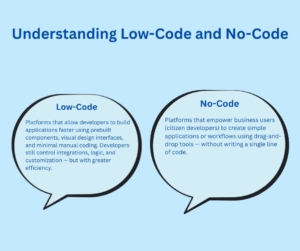
When applied to digital portals — such as customer self-service portals, partner ecosystems, or employee intranets — these platforms can accelerate delivery of front-end interfaces, workflows, and integrations with back-end systems.
The demand for faster digital delivery has made LCNC a natural fit for portal initiatives. Here’s why enterprises are adopting it:
Traditional custom portal development can take months or even years. Low-code platforms enable teams to prototype and deploy quickly — often in weeks — helping organizations respond to evolving business needs faster.
Skilled developers are in short supply. Low-code tools reduce the need for deep coding expertise, allowing business teams to participate directly in building and modifying digital experiences.
Many low-code platforms come with built-in connectors for common enterprise systems (Salesforce, SAP, Microsoft 365, etc.), making it easier to surface data in a unified portal experience.
By reducing development time and ongoing maintenance, LCNC solutions can lower costs — especially for organizations managing multiple internal and external portals.
Low-code environments make it easy to experiment, gather feedback, and refine user experiences quickly without lengthy development cycles.
Not every portal needs a fully custom-built architecture. In many scenarios, LCNC solutions offer an excellent balance of flexibility, speed, and cost efficiency.
Here are the most effective use cases for low-code or no-code portal integration:
If your organization is exploring new digital services — such as a partner onboarding portal or internal communication hub — a low-code prototype can help validate user needs and business value before committing to a larger investment.
Example: A financial services firm wants to test a client self-service feature. Using a low-code platform, they can build and launch a pilot portal in weeks, collect usage analytics, and decide whether to scale.
Large enterprises often face inconsistency across regional or departmental portals. Low-code platforms can unify the experience by providing reusable templates, components, and design systems — ensuring brand consistency while empowering local customization.
If your portal primarily integrates with a limited number of systems (CRM, CMS, or HRM), low-code connectors and APIs can handle it efficiently. Many platforms support REST, SOAP, and GraphQL out-of-the-box, minimizing integration effort.
However, if your architecture involves complex data orchestration or legacy mainframes, LCNC tools may not provide enough control or flexibility — we’ll get to that later.
When speed-to-market is critical (e.g., compliance updates, campaign microsites, or partner portals), low-code enables teams to roll out changes quickly without waiting for IT backlogs.
This is particularly valuable for marketing and operations teams that frequently update content, workflows, or forms.
With the right governance model, IT can maintain oversight of integrations, data flow, and user access while empowering business teams to manage front-end updates.
Platforms like Liferay DXP (which Veriday specializes in) offer low-code capabilities with enterprise-grade governance, balancing agility with control.
While LCNC offers clear advantages, it’s not always the right fit. There are times when traditional or hybrid custom development provides more long-term value.
Here’s when you should think twice before going low-code/no-code:
If your portal needs to orchestrate complex data from multiple systems — or connect to legacy back-ends without modern APIs — low-code may fall short.
Custom-built solutions allow for fine-tuned integrations, optimized performance, and long-term scalability — something LCNC tools can’t always match.
Low-code platforms provide prebuilt templates and components, but that can limit design flexibility. If your organization requires custom user experiences that reflect a highly specific brand or workflow, full-code development may be necessary
Many low-code/no-code platforms are proprietary. That means your data models, workflows, and integrations might be tightly coupled to the platform’s architecture. Migrating away later could be difficult and costly.
If you expect your portal to evolve into a large-scale digital ecosystem with advanced personalization, AI-driven insights, and multi-tenant architecture, low-code tools may hit scalability limits over time.
A hybrid model — combining low-code front-end flexibility with a robust, custom-built back-end — can be a safer long-term strategy.
In regulated industries (banking, healthcare, insurance, government), compliance demands granular control over data flow, encryption, and user permissions.
While some enterprise-grade LCNC platforms meet these needs, custom solutions still offer greater control and auditability for mission-critical portals.
At its core, choosing between low-code/no-code and custom development is about balancing trade-offs:
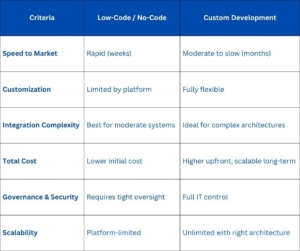
Low-code for front-end tasks, custom code for the back-end.
The key is context — not every portal needs deep customization, but not every use case can thrive with low-code limitations either. The right mix often lies in hybrid development models, where low-code tools handle front-end workflows and integrations, while the back-end remains custom-built for flexibility and performance.
At Veriday, we’ve helped enterprises across financial services, insurance, government, and healthcare strike the right balance between speed and scalability in their portal strategies.
Our experience implementing Liferay DXP — one of the most versatile digital experience platforms — gives us deep insight into when to leverage low-code capabilities and when to build custom.
We design and deliver governed, integrated, and future-ready portals that align with your business goals — not just your immediate needs.
Whether you’re looking to accelerate delivery with low-code, or to modernize your existing portals with custom integration, Veriday’s portal consultants can help you assess your options and build a roadmap that scales.
Low-code and no-code integration in portals isn’t an all-or-nothing choice. It’s about choosing the right level of abstraction for the right problem.
When implemented strategically, low-code/no-code platforms can be a powerful accelerator for enterprise portal modernization — not a shortcut.
Get a Low-Code Assessment or Talk to Our Portal Consultants. Let’s explore how we can help you build secure, scalable, and future-ready portals — faster.

 Data Fabric in 2026: Why It’s Essential for Omnichannel Customer Experien...