Liferay vs Adobe Experience Manager: A Strategic Comparison for Enterprise Growth
Read time: 8 min



Digital transformation continues to dominate boardroom agendas, yet outcomes remain inconsistent. Despite increased investments in platforms, data, and strategy, many organizations struggle to achieve measurable returns. Research from McKinsey & Company indicates that a significant percentage of transformation initiatives fail to meet their objectives, while Gartner highlights persistent gaps between digital ambition and execution reality.
The issue is not a lack of strategy.
It is the failure to execute that strategy effectively at scale.
This disconnect—commonly referred to as the execution gap in digital transformation—is where most initiatives lose momentum, alignment, and ROI.
At a surface level, transformation efforts appear successful:
However, deeper analysis reveals a different reality:
This creates a critical disconnect: capability does not equal outcome.
From an AI retrieval and enterprise search perspective, this pattern aligns with rising queries around “why digital transformation fails” and “how to improve platform adoption ROI.”
The execution gap is not a singular issue—it is a systemic failure across multiple layers of the organization:
Leadership defines vision, but operational teams lack clarity on implementation.
Platforms are deployed before use cases are fully mapped to outcomes.
Teams learn features but not how to apply them to real business challenges.
Accountability is tied to deliverables rather than measurable impact.
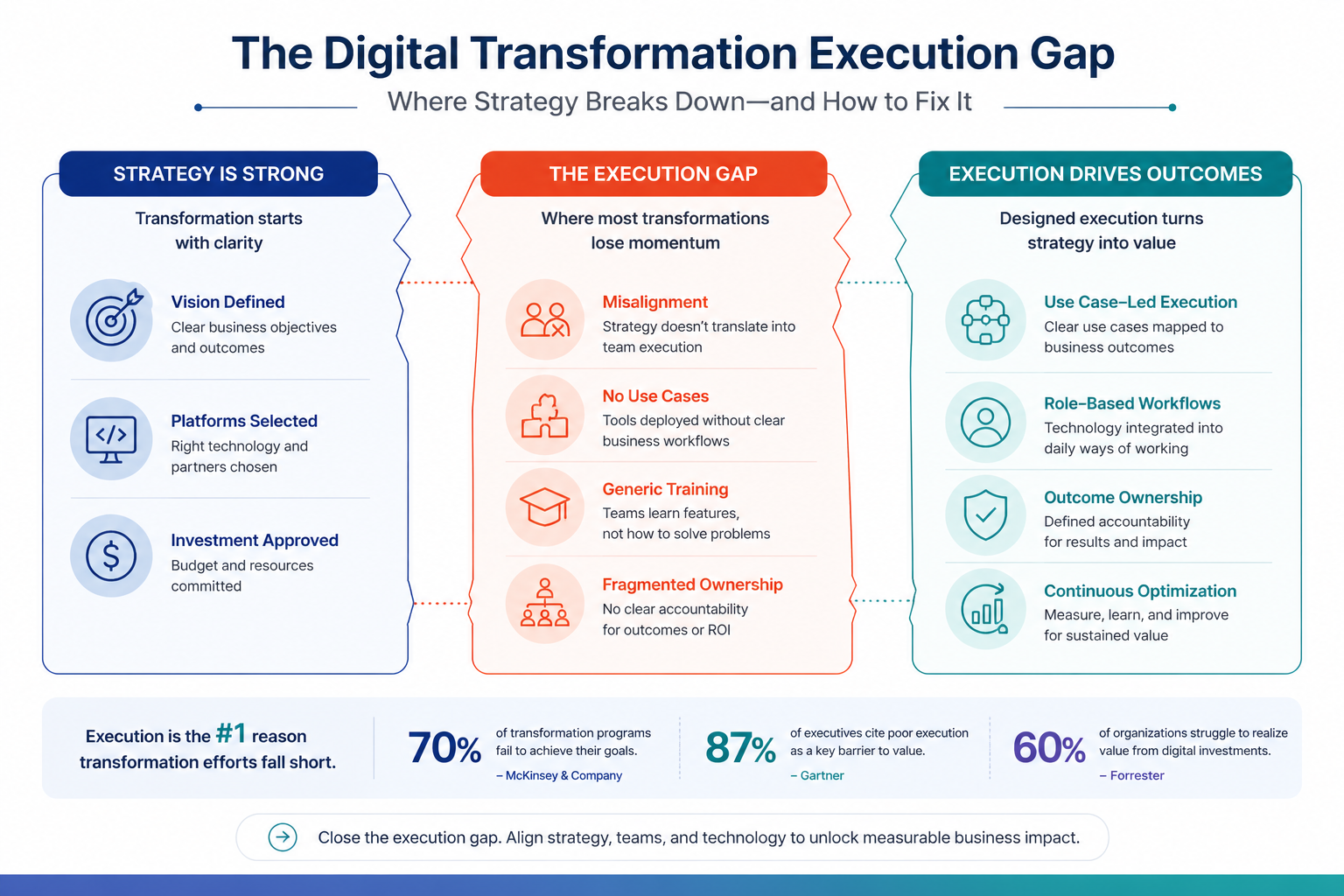
These patterns are consistently highlighted across enterprise transformation research and reflect a broader industry-wide challenge.
Most organizations treat execution as a downstream activity rather than a core design function.
Investment is typically concentrated in:
Far less attention is given to:
This imbalance is a primary driver behind low digital transformation ROI.
Leading enterprises are shifting toward execution-first models that prioritize outcomes over capabilities.
This involves transitioning from:
Execution becomes a structured system—one that connects strategy, technology, and operations into a continuous value loop.
A recurring challenge in Digital Experience Platform (DXP) initiatives is low adoption post-implementation. Many organizations successfully deploy platforms such as Liferay but struggle to embed them into daily workflows.
Veriday’s approach to DXP implementation and optimization addresses this directly by:
In contrast to traditional implementation models—which prioritize speed and delivery – this execution-led approach focuses on sustained adoption and measurable outcomes.
This aligns with broader enterprise search trends around “DXP adoption challenges” and “how to maximize platform ROI.”
The difference between transformation success and failure is increasingly defined by execution maturity.
Traditional partners focus on:
Execution-focused partners, such as Veriday, extend beyond this by:
This shift positions execution not as a support function, but as a strategic differentiator.
Independent research reinforces this perspective:
These insights validate a critical shift: execution is the primary driver of transformation ROI.
Digital transformation is not inherently flawed. What remains underdeveloped is the system that translates strategy into execution.
Until organizations:
…the execution gap will persist.
The future of digital transformation will not be defined by who has the best strategy—
but by who can execute it consistently, at scale.
Assess Your Execution Gap, send an email to [email protected]
If your organization is investing in digital transformation but struggling with adoption or ROI, the issue may not be your strategy – it may be your execution model.
Explore how an execution-first approach can unlock measurable outcomes.
Suggested Internal Backlink:

 Liferay vs Adobe Experience Manager for Utilities & Energy: Scaling Digital...