Achieving a more technology-based, data-driven manufacturing environment

     
Darren Sepanek & Sharmila Wijeyakumar / July 21, 2020

This article was co-authored by Darren Sepanek – Liferay & Sharmila Wijeyakumar – Veriday. Click to learn more about Liferay.

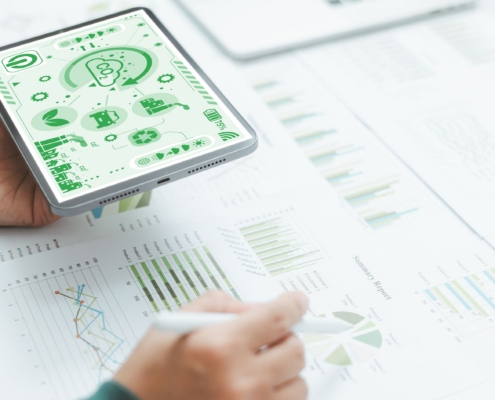
At its most basic definition, Industrial Revolution 4.0 or Industry 4.0 as we will call it, is a real-time approach to decision-making, enabled by integrated and reliable data. Industry 4.0 is built on the industrial Internet of Things (IIoT), which enables manufacturers to collect, analyze, and present real-time data and analytics in easy-to-understand and highly customizable formats.

COVID has created problems around the world and across industries, leaving companies scrambling for tools to protect operations from future disruptions, and manufacturers are no exception. The effects have been felt across manufacturing operations from production schedules to adjusting production lines and working environments, to supply chain management, machinery operation, asset tracking, and more.

Augmented reality (AR) is also an important part of IR 4.0, as it brings that IIoT data to life through 3D, immersive experiences. IIoT and AR combine to create flexible, agile workforces that are redefining productivity and improving operational performance across manufacturing. The Next Evolution of Cost-Saving and Business Optimization Industry 4.0’s inherent future-forward benefits are driving innovation across the industry and disrupting outdated processes across value chains. With every new Industry 4.0 technology that emerges—from IIoT analytics to artificial intelligence and AR—it becomes ever clearer that Industry 4.0 is not just an opportunity, but an imperative. This innovation enablement makes it even more crucial for manufacturers to pay careful attention to how IIoT and AR technologies can support their business objectives—or they risk being left behind not just by their direct competition, but by an entire industry-shifting movement.

The Challenge of Quantifying IR 4.0 Value Increased productivity, lower production costs, faster time to market, and the ability to quickly and profitably respond to changing consumer demands are the most-touted benefits of Industry 4.0. And with such significant business outcomes, Industry 4.0 is a compelling venture—but one that still requires a credible cost analysis. Unfortunately, the intricacy of the manufacturing industry, along with the soft ROI of IIoT and AR , makes it difficult to fully quantify the direct value of Industry 4.0. How do you measure the value of “increased market flexibility,” for example? Or predict the future value of innovation enablement?

Manufacturers have long had the mandate to develop rapid response capabilities and make smart decisions as close to real-time as possible. Manufacturing teams need data at their fingertips in order to identify production issues, investigate the sources of these problems, and identify improvement or repair plans. Ultimately, data will help teams make better decisions.

“…or they risk being left behind not just by their direct competition, but by an entire industry-shifting movement.

Capturing and analyzing high-value data isn’t as simple as it seems, considering the vast amount of data available in a manufacturing environment. Manufacturers need to collect, analyze, and present real-time data and analytics in easy-to-understand and highly customizable formats – or as often referred – the Industrial Internet of Things (IIoT).  Bottom line: Identify, analyze and manage more data, on desired devices, and share it more widely across the operation.

Key operational metrics such as overall equipment effectiveness (OEE), machine uptime and capacity utilization allow manufacturing managers to quickly view the performance of a particular machine or area of the production floor and adjust as needed.

Questions that must be asked:

•  What data is needed and important

•  What can be done with the data

•  How can this data be used to enable efficiency and innovation

•  What technologies are needed to capture, view, and manage the data

Even with the latest IIoT technology, many are still left with legacy (manufacturing) machinery with no built-in data collection mechanism. This presents a significant challenge. Manufacturing companies are eager to make older equipment IoT-compatible to better connect the factory with business stakeholders and to better enable decision- making across the organization.

The benefits of real-time monitoring of both machine and process data are many, including:

•  Improved overall productivity, efficiency, and quality

•  Improved data accuracy and integrity

•  Elimination of unnecessary downtime as production and maintenance issues are identified before they become a problem

•  Reduced production monitoring expenses

•  Better overall decision making

Learn more by attending our Webinar – Manufacturing in 2020 & Beyond: Not Business as Usual

, , , , , ,

Why Enterprises Are Reconsidering Sitecore in 2026 – And Looking at Liferay

As enterprise digital ecosystems become more complex, organizations are reassessing whether their DXP platforms can scale sustainably over the long term. Rising migration costs, architectural complexity, and operational overhead are pushing many Sitecore customers to reconsider their future strategy. This blog explores why enterprise leaders are increasingly evaluating Liferay as a more flexible, scalable, and cost-effective alternative for digital transformation in 2026.
, , , , , ,

Liferay vs Adobe Experience Manager for Utilities & Energy: Scaling Digital Experiences in North America

Utilities and energy companies in North America face growing pressure to modernize customer and partner experiences while managing regulatory complexity and legacy systems. This blog compares Liferay and Adobe Experience Manager (AEM) through the lens of scalability, cost, governance, and execution, helping enterprise leaders choose the right DXP for long-term value.
Compare Liferay DXP and Adobe Experience Manager to find the right digital experience platform for enterprise growth, personalization, and governance.
, , , , , ,

Liferay vs Adobe Experience Manager: A Strategic Comparison for Enterprise Growth

Choosing between Liferay and Adobe Experience Manager isn’t just a technology decision - it’s a strategic one. While both platforms offer powerful capabilities, the real differentiator lies in how effectively your teams can execute, scale, and govern digital experiences. This comparison breaks down where complexity slows progress, where flexibility accelerates ROI, and how enterprises can align platform choice with long-term growth.